
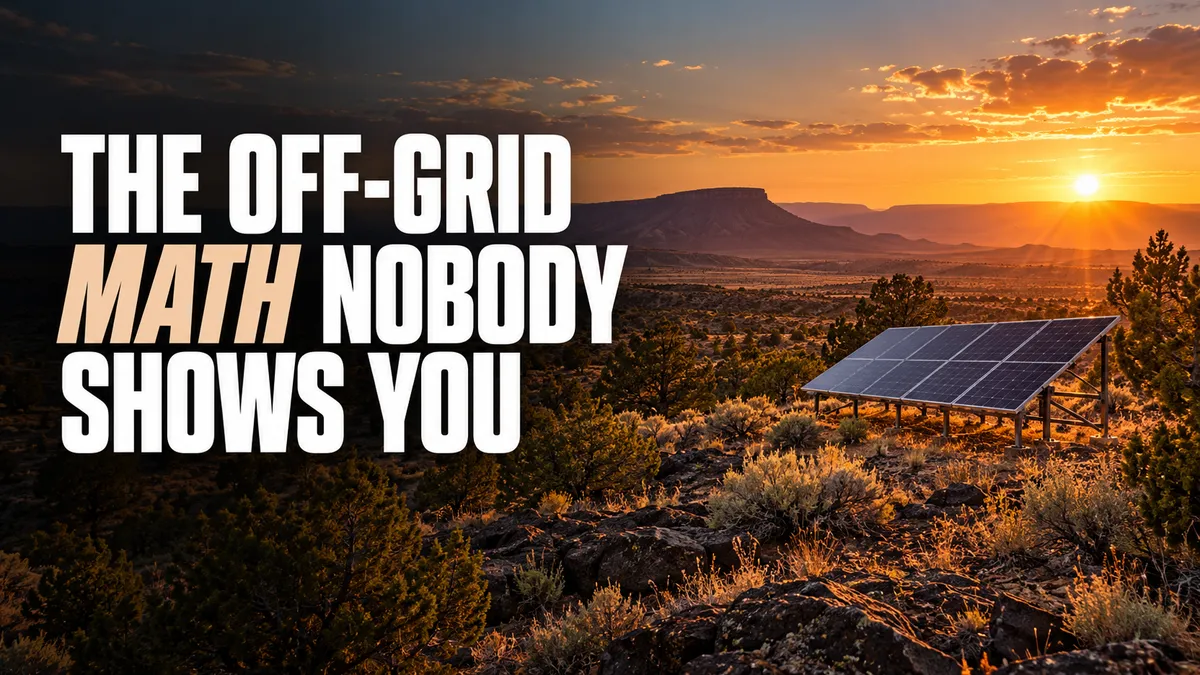
THE OFF-GRID MATH NOBODY SHOWS YOU: What Power, Permits, and Equipment Actually Cost on Raw Arizona Land
"Off-grid" sounds like the end of paperwork and utility bills. In practice, it's the start of a different set of decisions, ones that are a lot easier to make well before you own the land than after you're standing on it wondering how to run a refrigerator. Here's an honest look at what actually goes into powering a parcel that isn't connected to anything, and what still requires a permit even though nobody's sending you a monthly bill.
"Off-Grid" Means You're Building a Small Power Plant, Not Skipping One
When a house is tied into the grid, a utility company handles generation, storage, and reliability, and you just pay for what you use. Off-grid, you're taking on all three of those jobs yourself, on a much smaller scale. That's not a reason to avoid it, plenty of people do it successfully, but it's worth being clear-eyed that "no utility bill" doesn't mean "no system to design, size, and maintain." Every piece of that system, not just the panels on the roof, has to actually work together.
How Much Power You Actually Need, Compared to What You're Used To
A useful starting point is the average grid-connected home. According to the U.S. Energy Information Administration, the average American residential electric customer used 10,791 kilowatt-hours in 2022, or roughly 30 kWh a day. That number includes central air conditioning, an electric water heater in many homes, and appliances nobody thinks twice about plugging in. A realistic off-grid setup almost never tries to match that. Most off-grid households get there by cutting the big draws first: propane or wood for heating, cooking, and often water heating, efficient LED lighting, and a smaller fridge and well pump instead of full-size everything. Done that way, a genuinely minimal off-grid cabin can often run on a small fraction of that 30 kWh average, but "small fraction" still has to be calculated honestly for your actual appliances, not assumed.
The Four Things Every Off-Grid Power System Needs
Whatever size you land on, the system itself has the same four pieces. Solar panels generate power during daylight. A charge controller regulates how that power flows into the batteries so they charge safely instead of getting damaged. The battery bank stores power for use at night or during cloudy stretches, and it's almost always the single most expensive part of the system. An inverter converts the batteries' stored DC power into the standard AC power your appliances actually run on. Skip or undersize any one of those four pieces and the whole system underperforms, which is why "I bought some solar panels" and "I built a power system" are two different projects.
Why Battery Bank Size Is the Real Budget Decision
The number that actually drives most of your cost is "days of autonomy," meaning how many cloudy or low-sun days your battery bank needs to cover before you're out of stored power. A bare-minimum setup might budget for one day of backup and accept some risk during a stretch of bad weather. A setup built for year-round, no-excuses reliability budgets for several days and costs meaningfully more, because batteries are priced by how much energy they can store, not by how many panels sit on your roof. This is the decision worth spending real time on before you buy equipment, not after: how much risk of running out of power on a bad week are you actually comfortable with.
The Backup Generator Nobody Budgets For
Most off-grid systems, even well-designed ones, pair solar with a backup generator, usually propane or gasoline, for the stretch of days solar and batteries alone can't cover. It's not a sign the solar system failed, it's a normal part of a realistic off-grid plan, the same way a backup sump pump isn't a sign your main one is broken. Leaving a generator out of the budget entirely is one of the more common ways people underestimate what a reliable system actually costs to put together.
Yes, You Still Need a Permit
Here's the detail that surprises people most: going off-grid doesn't generally mean going permit-free. Solar and battery installations are typically treated like any other structure or electrical work for permitting purposes, and in Arizona that usually means a county (or city, inside incorporated limits) electrical permit, not just a courtesy filing. Maricopa County, for example, requires a permit for residential solar installations, issued same-day for most straightforward systems. Permit rules do vary by county and by system size and type, so this is genuinely a "call your specific county's planning or building department before you install anything" situation, not a one-size-fits-all answer. The honest version of "off-grid" is "off the utility grid," not "off the county's radar."
What This Means for Water and Septic Too
The same logic extends past electricity. A well still needs a permit through the Arizona Department of Water Resources before you drill it, and a septic system still needs a permit through your county, acting on the Arizona Department of Environmental Quality's behalf, before you install one. Neither of those systems disappears just because you're not connected to a municipal water or sewer line. If you're planning a fully self-sufficient parcel, it's worth budgeting time and paperwork for power, water, and waste as three separate permitting conversations with your county, not one.
What to Actually Do Before You Buy Equipment
A few steps make this whole process far less of a surprise later. Call your specific county's planning or building department before buying anything, since requirements genuinely differ county to county. Write down your actual appliance list and realistic daily hours of use before sizing a system, rather than buying equipment first and hoping it's enough. Price out the battery bank and a backup generator as part of the same budget, not as optional add-ons you'll deal with later. And talk to an installer who's actually done off-grid systems in your specific area, since someone used to grid-tied residential solar may not think through autonomy days and generator backup the same way.
The Bottom Line
Going off-grid on raw Arizona land is genuinely doable, and plenty of Wild Acres owners build toward exactly that. It's just not the paperwork-free, bill-free fantasy it sometimes gets sold as. You're building a small power system, usually a well and sometimes a septic system too, and all three still answer to a permit process even though none of them answer to a utility company. Planning for that honestly, before you've already bought equipment, is what actually makes off-grid living work instead of becoming an expensive lesson.