
Mobile Home Living vs RV Living in Arizona: Which One Actually Makes Sense
There's a moment when every person considering off-grid Arizona living faces the same question: Should I buy a mobile home or an RV?
On the surface, they seem similar. Both are non-traditional housing. Both are more affordable than traditional homes. Both let you escape the suburban grind. But when you actually sit down and think about living in one or the other for years — not months, years — the differences become very real. And choosing wrong can cost you thousands of dollars and a lot of regret.
I've watched people make both choices, and I've learned something important: The right choice depends entirely on what you actually want from your life in Arizona. There's no universal answer. But there are real tradeoffs, and understanding them matters more than you'd think.
What You're Actually Choosing
Let's start with the basics, because a lot of people confuse mobile homes and RVs or think they're interchangeable. They're not.
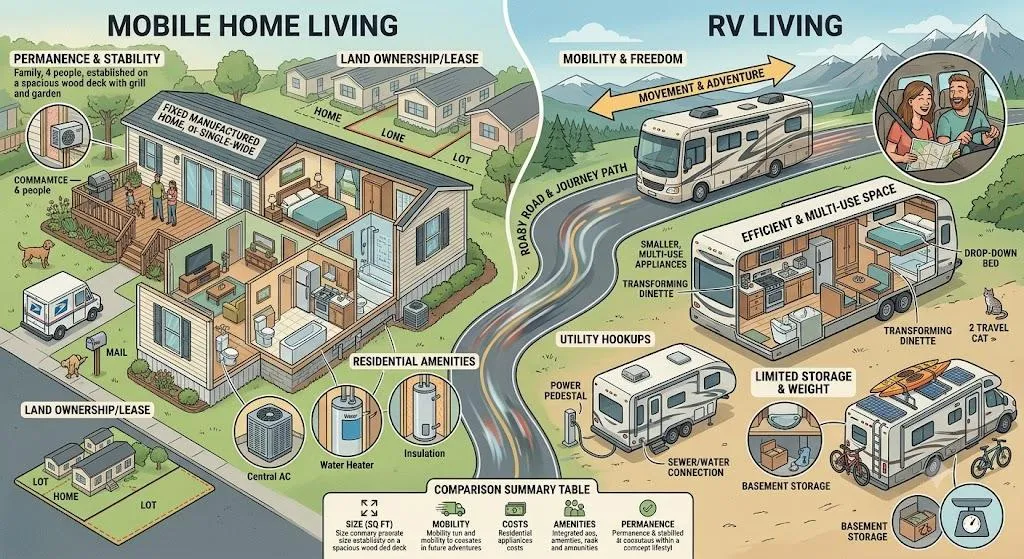
A mobile home is a permanent or semi-permanent structure. It sits on land. It has a foundation (concrete blocks, piers, or a real foundation). It's designed to stay in one place. Think of it as a house that's built in a factory instead of on-site, but once it's placed, it's staying there. You can move it, but moving a mobile home is expensive, complicated, and damages the structure. Most people don't move them. They're meant to be stationary.
An RV is literally a vehicle. It's designed to move. It has wheels. It has a hitch or engine. The whole point is that you can drive it to different locations. Some people stay in one spot for years, but the vehicle itself is mobile. That's the fundamental design.
This difference changes everything about how you actually live.
Mobile Homes: The Stability Option
A mobile home in Arizona costs somewhere between $10,000 and $40,000 depending on age and condition. You can find decent used ones for $15,000-25,000. Then you place it on your land. You set up utilities (well, septic, solar, whatever your situation requires). And you live there.
The advantage of a mobile home is stability. Once it's placed, it's home. Your kitchen has real cabinets. Your bedroom isn't 8 feet long. You can have a living room that's actually a living room. If you're building a life in Arizona, a mobile home feels like a real home. Your guests don't feel like they're visiting you in an RV. Your neighbors see it as a house, not a vehicle.
Mobile homes also appreciate, or at least maintain value, if they're in decent condition. Your RV depreciates the moment you drive it off the lot. But a well-maintained mobile home on good land in a growing area can actually gain value. Not always — location and condition matter — but it's possible.
The downside of a mobile home is that it's not truly mobile. If you discover you hate the location, moving is expensive and painful. You're anchored to that piece of land. And if your land doesn't work out the way you thought, you're stuck with a mobile home on bad land, which is a miserable combination. Also, mobile home parks are a thing in Arizona, and if you're placing a mobile home in a park, you're subject to HOA-style rules that you might have bought land to escape from.
Long-term, a mobile home makes sense if you're confident about the location and you want something that feels like an actual home. If you want to build something permanent, a mobile home is a good foundation.
RVs: The Flexibility Option
An RV costs between $10,000 and $50,000 depending on what you buy. A basic used Class C or travel trailer at the lower end. A Class A or fifth wheel at the higher end. Then you park it on your land. You set up utilities the same way — well, septic, solar, whatever.
The advantage of an RV is flexibility. If you hate the location, you can move. If the land doesn't work out, you can relocate the RV and try somewhere else. This sounds nice in theory. In practice, most people stay put. Moving an RV every few months is expensive and exhausting. But knowing you can move is psychologically valuable. It's the difference between feeling trapped and feeling flexible.
RVs are also simpler to set up. You park it. You connect utilities. You're done. There's no foundation work, no permanent installation. Everything is designed to be temporary, so it's easy to install and uninstall.
The downside is that RVs are depreciating assets. Your $20,000 RV will be worth $10,000 in five years. Mobile homes don't depreciate as fast. Also, RVs feel like RVs. Your kitchen is tiny. Your shower is closet-sized. Your bedroom is 8 feet long. Living full-time in an RV means accepting a very compressed living space. Some people love this. Others find it suffocating after a few months.
RVs also have more maintenance. They're vehicles. Things break. Seals fail. Roofs leak. Water systems freeze. Engines need maintenance. Mobile homes, while not maintenance-free, don't have the complexity of a vehicle that's also a home.
The Financial Reality
Over ten years, the math is interesting.
Mobile home route: Buy $20,000 mobile home + place it on land ($2,000-5,000) + utilities setup ($15,000) = $37,000-40,000 upfront. Value after 10 years: roughly $15,000-25,000 (depending on market). Monthly costs (property tax, maintenance, utilities): $100-300. Total 10-year cost: roughly $50,000-55,000. You own an asset worth $15,000-25,000.
RV route: Buy $20,000 RV + utilities setup ($15,000) = $35,000 upfront. Value after 10 years: roughly $8,000-12,000 (significant depreciation). Monthly costs (maintenance, replacement parts, propane, utilities): $150-400. Total 10-year cost: roughly $55,000-65,000. You own an asset worth $8,000-12,000.
Mobile homes cost slightly more upfront but hold value better. RVs cost less upfront but depreciate faster and have higher maintenance costs. Over the long term, mobile homes are slightly cheaper. But the difference isn't dramatic.
The Lifestyle Reality
This is where it gets personal.
If you're 65 years old and you want to settle into one place and never move again, a mobile home is better. You want a real home. You want stability. You don't need flexibility.
If you're 35 and you're not sure where you want to be long-term, an RV is better. You want to try different locations. You want to know you can leave if it doesn't work out.
If you're building something semi-permanent — you have kids, you're starting a business, you want to put down roots — a mobile home is better. It feels like a real home. It's a foundation.
If you're still in the exploration phase — you're testing off-grid living, you're not sure if Arizona is the place, you want options — an RV is better. Stay mobile until you're sure.
If you care about interior space and comfort, a mobile home wins. RVs are cramped. Period.
If you want something that feels genuinely mobile and you're okay with compact living, an RV works.
The Arizona-Specific Consideration
Arizona heat affects RVs and mobile homes differently. RVs, being smaller, heat up faster and are harder to cool. Your AC runs constantly in summer. Mobile homes have more mass, so they stay cooler longer, and your AC is more efficient. This matters when you're paying for your own solar power. An RV will drain your battery faster on a hot day.
Arizona cold affects them similarly. Mobile homes maintain heat better. RVs lose heat faster.
Arizona humidity is low, so neither is at risk of mold problems the way they might be in other states. That's a win for both.
The Real Question
Before you choose, ask yourself: Am I running from something or running to something?
If you're running from something (bad job, bad relationship, bad city), you might need an RV. You need flexibility. You need to know you can leave if it's still not working.
If you're running to something (off-grid lifestyle, Arizona living, land ownership), you probably need a mobile home. You're building something. You need stability.
The answer to this question predicts which choice will make you happy. Get it wrong, and you'll spend five years in an RV wishing you had a real home, or you'll spend five years in a mobile home feeling trapped because you realize you should have stayed flexible.
