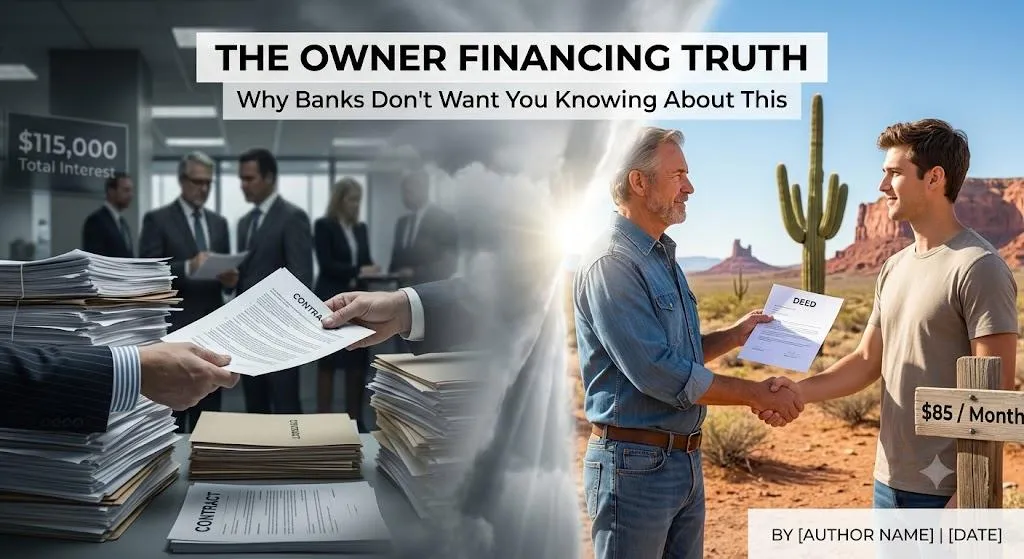
Why Banks Don't Want You Knowing About This
Nobody wants to admit it, but the entire real estate industry is built on one simple truth: someone makes money from your complexity.
Banks make money when you don't understand mortgages. Real estate agents make money when you think you need them. Appraisers, inspectors, title companies—they all profit from the process being complicated and expensive.
Owner financing cuts through all of it. And that's exactly why nobody talks about it.
The Real Reason Banks Hate Owner Financing
A bank doesn't make money selling you land. A bank makes money from the interest you pay on the loan.
You borrow $100,000 at 6% interest over 30 years. You pay back approximately $215,000. That extra $115,000? That's the bank's profit. That's what they're really selling.
Owner financing? The seller finances it. They're not looking to make $115,000 in interest. They just want to sell the land and get paid monthly. The seller's profit is the sale price, period.
This is why you see ads for mortgages everywhere. Banks have massive marketing budgets. They're fighting for your business because your business makes them rich.
Owner financed properties? You won't see ads. The seller isn't trying to convince millions of people to buy. They just want to find the right buyer who will pay monthly.
What Owner Financing Actually Changes
Let's be honest about the traditional mortgage path.
You go to a bank. You need approval. They check your credit score. They verify your income. They order an appraisal. They order an inspection. They run background checks. They review tax returns. They look at your debt-to-income ratio.
Then they charge you fees for all of this:
Origination fee: $3,000
Appraisal: $500
Title search: $800
Closing costs: $2,000
Insurance: $1,500
Processing: $500
You haven't even bought the property yet and you're $8,000 in the hole.
Then you sign a 30-year mortgage. You spend 30 years paying interest to a bank for the privilege of owning something.
Owner financing? You call the seller. You agree on a price. You pay the price. You own it.
No bank approval. No credit score gatekeeping. No $8,000 in fees. No 30 years of interest payments.
Just ownership.
The Psychology of the Traditional Path
Here's what's insidious about the traditional mortgage system: it makes you feel like you're doing the right thing.
You go through the approval process. It's hard. It's complicated. It requires lots of documentation. This must mean it's legitimate, right? This must mean it's the safe way to do it?
That complexity isn't safety. It's a moat. It's designed to make you believe that there's only one way to buy property, and that way requires a bank.
There are other ways. Owner financing is one of them. It's older than modern banking. It's how property changed hands for centuries before banks decided they should be in the middle of every transaction.
But because banks have marketing budgets and owner financing doesn't, you've been convinced that owner financing is either: (a) not real, (b) sketchy, or (c) only for people who can't get real mortgages.
None of that is true.
Owner financing is the default for people who understand that a bank in the middle doesn't make anything better. It makes things more expensive.
What Actually Happens with Owner Financing
You find a property. You contact the owner. You negotiate a price and terms.
Let's say the land is $5,000. You agree on $85/month for 60 months (5 years). The owner finances it. You own it from day one.
There's no approval process because the owner is making the decision, not a bank. The owner knows: if you don't pay, they can take the land back. That's enough security for them.
You pay $85/month. All $85 goes toward your ownership. There's no interest going somewhere else. There's no bank taking a cut. There's no middleman.
Five years later, the land is paid off. It's worth more than $5,000 now (appreciation happens). You own it outright. No mortgage. No bank. No debt.
You just own something.
Why This Terrifies Banks
If everyone understood this, banks would lose a significant income stream.
Mortgages are one of the most profitable products banks offer. Not because mortgages are evil—they serve a purpose for people buying expensive properties. But because mortgages are profitable, banks have spent decades convincing you that there's no other way.
That's not true. Owner financing is another way. A simpler way. A cheaper way.
Banks know this. That's why you don't see owner financing talked about in mainstream real estate. That's why when you search for property online, owner financed properties are buried or absent. That's why real estate agents push you toward mortgages.
It's not because mortgages are better. It's because mortgages make more people money.
The Real Question You Should Be Asking
If owner financing is so sketchy and dangerous, why do smart people use it?
Because it works. Because it's simpler. Because it's cheaper.
There's nothing magical about it. There's nothing risky about it. It's just a direct agreement between two people: you pay money, the owner gives you the property.
That's it. That's the entire transaction.
The reason you haven't considered it is because nobody with a financial incentive has told you about it. Banks have a financial incentive to keep you thinking you need them. Real estate agents have a financial incentive to keep you thinking traditional paths are the only paths.
Owner financing doesn't make money for those intermediaries. So they don't talk about it.
What This Means For You
You have options. More options than you think.
You don't need a bank to own property. You don't need perfect credit. You don't need a huge down payment. You don't need an approval process that takes months.
You just need to find an owner who's willing to finance it directly.
Is this always possible? No. Not every property owner wants to owner finance. Not every seller trusts the process.
But when you find it? When you find an owner who's willing to finance directly?
You've found something the banks hoped you'd never discover: a way to own property that doesn't require giving a bank 30 years of your life and $115,000 in interest.
