
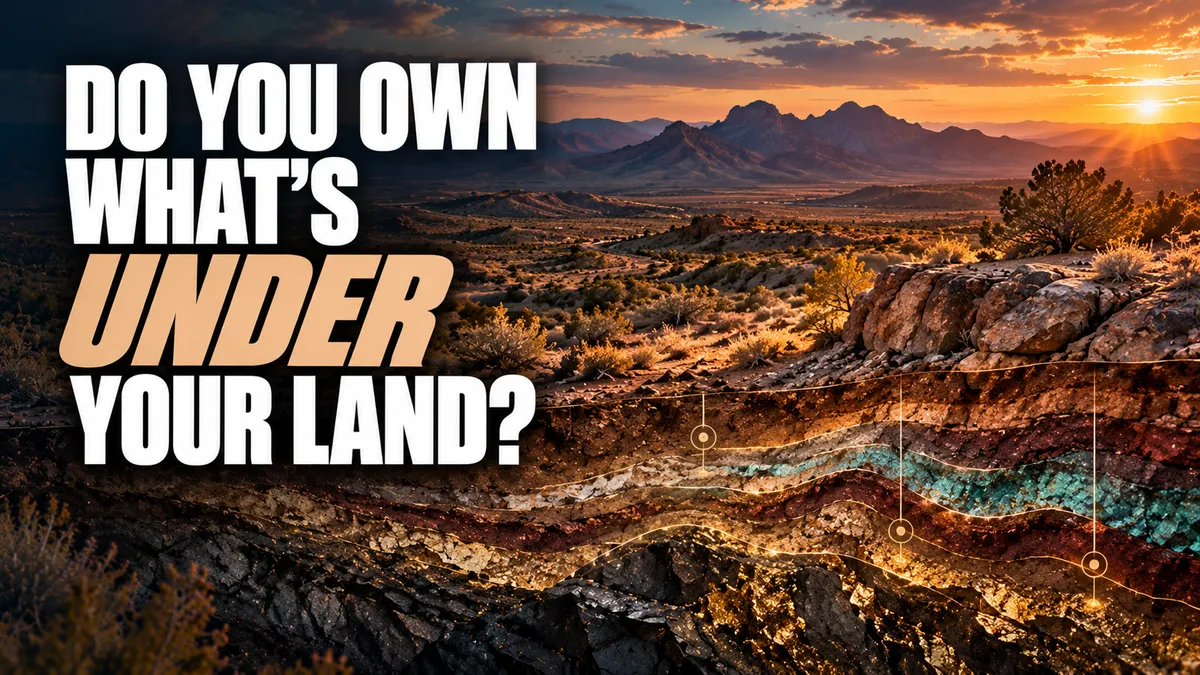
DO YOU ACTUALLY OWN WHAT'S UNDER YOUR LAND? The 1916 Law Behind Millions of Split Mineral Rights in the West, and Why Arizona's Lithium Boom Just Made It Matter
Most people assume buying land means owning everything about it, top to bottom. Across huge parts of the American West, that assumption is wrong, and it traces back to a law from 1916 that most landowners have never heard of. With a real lithium rush now underway across the Southwest, this stopped being trivia and started being worth actually checking.
The Legal Split Nobody Tells You About
The Bureau of Land Management has an official name for this: a "split estate." It's what happens when the surface of a piece of land belongs to one owner while the minerals underneath it belong to someone else entirely, often the federal government. According to BLM's own guidance, this situation shows up across many parts of the Rocky Mountain West, where a landowner can hold a perfectly valid deed to the surface and still not own a single ounce of what's underneath it.
How It Happened: A 1916 Law You've Never Heard Of
The split traces directly to the Stock-Raising Homestead Act of 1916, a federal law that let settlers claim up to 640 acres of designated public land, mostly for ranching rather than farming. The law required range improvements, not cultivation, and it came with a catch most homesteaders at the time barely noticed: it separated surface rights from mineral rights by design. As mineral exploration picked up in the decades after, the federal government kept the minerals on land patented under this act, even as the surface passed into private hands and eventually got bought, sold, and inherited down through generations of owners who may have never known the split existed.
The Scale Is Bigger Than Most People Realize
This isn't a rare technicality buried in a handful of old deeds. By 2006, the federal government administered subsurface mineral rights on roughly 700 million acres nationwide, and about 58 million of those acres had surface rights held privately or by a state, meaning someone else owns the land on top while the federal government owns what's underneath. That's an area larger than the state of Wyoming. Split estates aren't limited to SRHA parcels either, mineral deeds and mineral reservations created the same situation through private transactions, bank foreclosures, and railroad land grants going back over a century, and BLM notes that mineral owners generally aren't required to tell a surface owner the split even exists.
What Rights You Actually Keep on Split-Estate Land
If your land falls into this category, you don't lose everything, but the limits are real. BLM's guidance confirms a surface owner on SRHA-patented land can still develop water sources and infrastructure for grazing and forage crops, and can generally take minimal amounts of mineral material for personal use without a permit. What a surface owner cannot do is sell the minerals themselves, because they were never part of what was conveyed. And if the federal government or a leaseholder decides to extract those minerals, a 1993 federal amendment requires the mining party to notify the surface owner in writing first, submit a plan to minimize surface damage, get the surface owner's consent, and commit to full reclamation and compensation. Those protections exist specifically because Congress recognized how disruptive an uninvited mining operation on someone's working ranch or home could be.
Why This Suddenly Matters: The Lithium Rush
Here's why a 1916 law is relevant in 2026. Companies have staked claims on more than 100 new lithium mine projects across the United States, almost entirely concentrated in the arid Southwest, driven by electric vehicle and energy-storage demand that's expected to double in the years ahead. Only one lithium mine currently operates in the country, but industry watchers expect at least six new ones to be running by 2030. Seven potential lithium projects have already been mapped in Arizona specifically, though all are still in early stages, and federal policy under the current administration has made mineral extraction a top priority use of public lands, with shorter public comment periods than before. Most of these projects are still just exploring whether mining would even be financially viable, but the scale of interest is real, and it's happening in the same general region where split-estate land is common.
How to Actually Check What You Own
BLM's own advice is refreshingly direct: contact your local BLM field office. Staff there can check the master title plat for a specific parcel and trace the original land patent to determine whether surface and mineral rights were split at the time, and if so, which minerals were affected, since different homestead-era laws reserved different things. Arizona has several BLM field offices, including one in Kingman, that handle exactly this kind of records search. A title company or a real estate attorney can also trace mineral reservations and severances recorded against a specific parcel's chain of title, which is the more direct route if you already own land and want certainty rather than just the general category it falls into.
What This Means If You're Buying Raw Land
This isn't a reason to assume the worst about any specific parcel, and it's genuinely not something to lose sleep over. Most land transactions never involve a mineral dispute, and plenty of split-estate land has sat for a century without the mineral owner ever acting on it. It's simply a due-diligence category worth knowing exists, alongside water rights, easements, and zoning, the things a careful buyer checks rather than assumes. If a specific parcel's mineral history matters to you, checking the chain of title or calling a BLM field office is a straightforward, often free way to find out rather than guess.
The Bottom Line
A 1916 law most people have never heard of created a split in land ownership that still affects tens of millions of acres across the West today, and a real, fast-moving lithium boom is making that split relevant again after a century of mostly sitting dormant. None of this changes what you can do with the surface of land you own for grazing, building, or simply holding. It just means "I own this land" and "I own everything about this land" aren't always the same sentence, and it's worth knowing which one actually applies before you assume either way.